
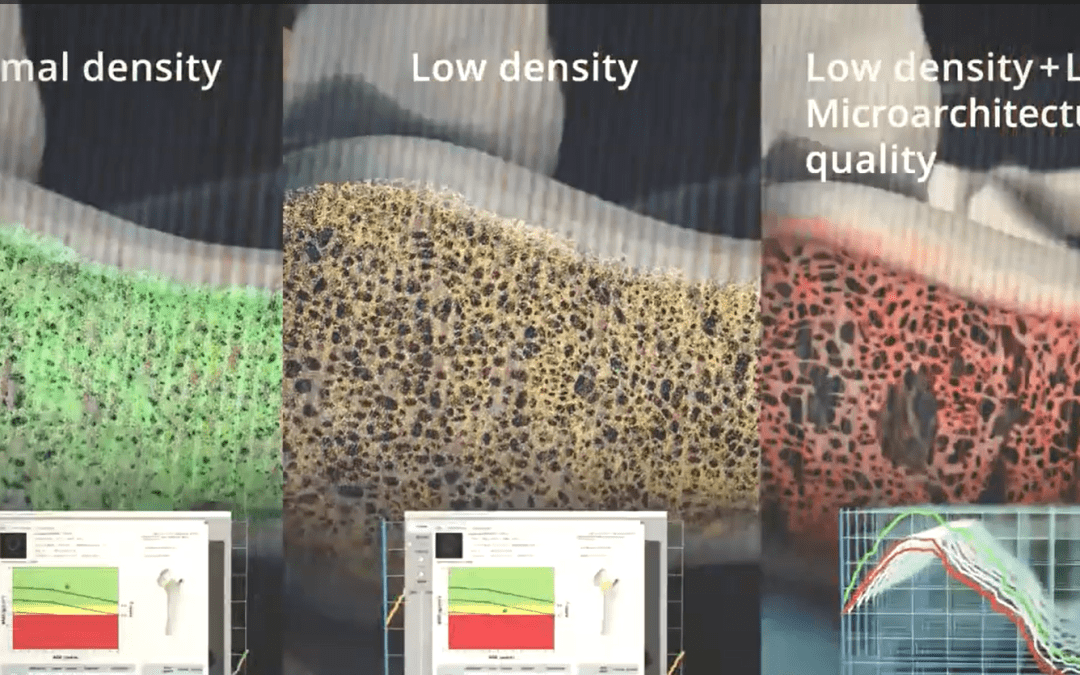
REMS: capable of providing information that goes beyond anthropometric modelling alone
“The manuscript entitled “Methodological clarification and analysis of demographic and anthropometric determinants in the calculation of REMS bone mineral density”, authored by Conversano F. et al. and very recently published in Calcified Tissue International, investigated an important question: to what extent can REMS-BMD be explained only by demographic and anthropometric variables, such as age, body weight and BMI?
To address this, the authors analysed a large dataset of 16,000 REMS scans from Caucasian women, including 8,000 scans of the proximal femur and 8,000 scans of the lumbar spine. Importantly, the analysis used independent development and test datasets, allowing the authors to verify whether the observed associations were reproducible beyond the original training sample.
The results show that, as expected, anthropometric parameters contribute to REMS-BMD, but they do not by themselves determine the final BMD value: a substantial part (typically over 40%) of the information remains linked to the ultrasound signal and to the bone characteristics detected during the scan.
Another positive aspect of the study is its methodological robustness. The highest explanatory values were observed only in training datasets, while performance decreased when the same models were tested on independent datasets. This highlights the importance of independent validation and shows that conclusions based only on same-cohort analyses may overestimate the role of anthropometric variables.

REMS in Nature Reviews Rheuma 2° Highlight
𝐑𝐄𝐌𝐒 𝐢𝐧 𝙉𝙖𝙩𝙪𝙧𝙚 𝙍𝙚𝙫𝙞𝙚𝙬𝙨 𝙍𝙝𝙚𝙪𝙢𝙖𝙩𝙤𝙡𝙤𝙜𝙮: 𝐚𝐬𝐬𝐞𝐬𝐬𝐢𝐧𝐠 𝐬𝐤𝐞𝐥𝐞𝐭𝐚𝐥 𝐟𝐫𝐚𝐠𝐢𝐥𝐢𝐭𝐲 𝐛𝐞𝐲𝐨𝐧𝐝 𝐁𝐌𝐃 In their review, 𝐰𝐡𝐢𝐜𝐡 𝐰𝐚𝐬 𝐜𝐨𝐧𝐝𝐮𝐜𝐭𝐞𝐝 𝐮𝐧𝐝𝐞𝐫 𝐭𝐡𝐞 𝐮𝐦𝐛𝐫𝐞𝐥𝐥𝐚 𝐨𝐟 𝐭𝐡𝐞 𝐖𝐇𝐎 𝐂𝐨𝐥𝐥𝐚𝐛𝐨𝐫𝐚𝐭𝐢𝐧𝐠 𝐂𝐞𝐧𝐭𝐫𝐞 𝐟𝐨𝐫 𝐄𝐩𝐢𝐝𝐞𝐦𝐢𝐨𝐥𝐨𝐠𝐲 𝐨𝐟 𝐌𝐮𝐬𝐜𝐮𝐥𝐨𝐬𝐤𝐞𝐥𝐞𝐭𝐚𝐥 𝐇𝐞𝐚𝐥𝐭𝐡 𝐚𝐧𝐝 𝐀𝐠𝐢𝐧𝐠, “𝑆𝑖𝑛𝑔𝑙𝑒-𝑐𝑜𝑚𝑝𝑜𝑛𝑒𝑛𝑡 𝑖𝑚𝑎𝑔𝑖𝑛𝑔 𝑎𝑛𝑑 𝑢𝑙𝑡𝑟𝑎𝑠𝑜𝑢𝑛𝑑-𝑏𝑎𝑠𝑒𝑑...

REMS in Nature Reviews Rheumatology
Nature Reviews Rheumatology highlights REMS among the most established technologies for fracture risk assessment. A major scientific review conducted under the umbrella of a WHO Collaborating Centre recognizes the growing clinical evidence supporting REMS technology...
REMS & DXA
REMS assessments: clinical settings REMS technology is recognized as useful tool in the management of osteoporosis and fracture prevention. Its portability and lack of ionizing radiation means it can be used in previously underserved populations, including pregnant...